
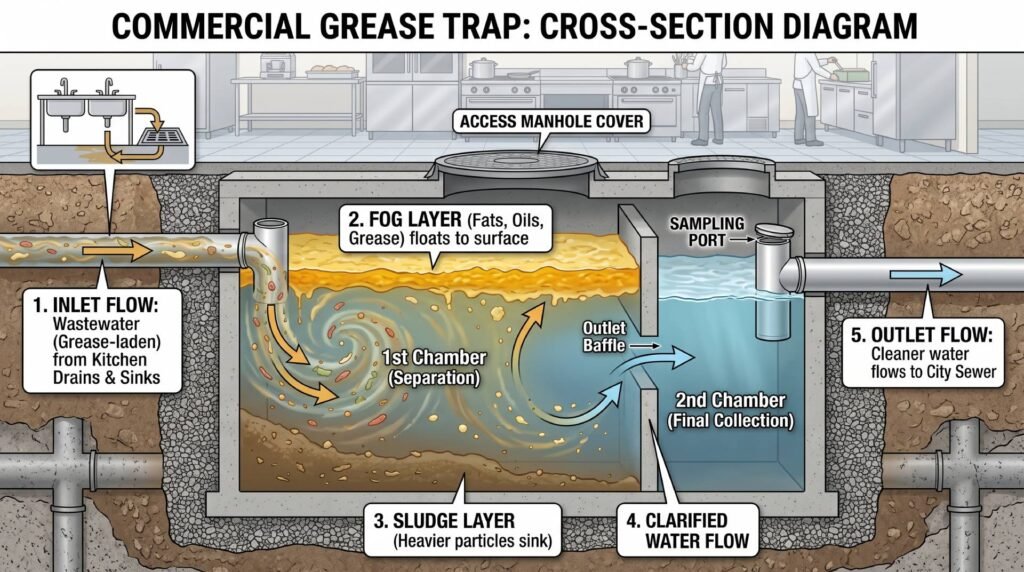
Installing or retrofitting a commercial kitchen in South Florida requires strict adherence to local environmental and wastewater codes. In Miami-Dade County, regulatory agencies closely monitor fats, oils, and grease (FOG) discharges. Consequently, property owners must stop kitchen waste from clogging sewage lines, causing sanitary sewer overflows, or contaminating the Biscayne Aquifer.
Furthermore, failing to install an approved grease trap can quickly halt commercial permitting, trigger heavy civil fines, or lead to failed building inspections. Therefore, this technical guide outlines the regulatory standards that county inspectors enforce, provides clear sizing formulas, and details local supply considerations.
1. Regulatory Framework: Miami-Dade DERM & FBC Standards
Commercial grease interceptor design in South Florida follows two core regulatory authorities:
-
Miami-Dade County Code Chapter 24 (Environmental Protection): The Division of Environmental Resources Management (DERM) enforces this standard to protect municipal sewer infrastructure and local groundwater tables.
-
Florida Building Code (FBC) – Plumbing, Chapter 10: This code governs physical fixture connections, venting layouts, cleanout placements, and verified flow ratings.
Kitchen Fixtures (Sinks / Drains)
          │
          ▼
   Flow Control Device (Air-Vented)
          │
          ▼
  Grease Interceptor (HGI or Gravity) ── DERM Approved Discharge
          │
          ▼
   Municipal Sewer Line
Under DERM standards, every Food Service Establishment (FSE)—including restaurants, cafeterias, bakeries, and commercial prep kitchens—must install an approved grease interception unit. In addition, contractors must submit engineering plans through the county plan review portal before plumbing officials will issue valid installation permits.
2. Grease Interceptor Types: Hydro-Mechanical vs. Gravity
Choosing the right interceptor depends heavily on kitchen flow volume, spatial constraints, and utility authority requirements.
| Feature | Hydro-Mechanical Grease Interceptors (HGI) | Gravity Grease Interceptors (GGI) |
| Typical Location | Indoors, under prep sinks or floor-mounted | Outdoors, buried underground |
| Capacity / Rating | Flow rate in Gallons Per Minute (GPM): 20 to 100+ GPM | Liquid storage volume: 750 to 2,000+ gallons |
| Material Construction | Heavy-duty Polyethylene, Fiberglass, or Stainless Steel | Reinforced Precast Concrete or Polyethylene |
| Flow Control | Requires an external, vented flow control valve | Uses natural gravity separation based on retention time |
| Common Application | Strip malls, urban spaces, small-to-medium kitchens | High-volume restaurants, supermarkets, industrial commissaries |
Hydro-Mechanical Grease Interceptors (PDI-G101 & ASME A112.14.3)
HGIs separate grease dynamically through internal baffles and air injection. Miami-Dade strictly requires that all HGIs hold current certifications from the Plumbing and Drainage Institute (PDI) under the PDI-G101 standard and comply with ASME A112.14.3.
Today, experienced contractors consistently prefer rotationally molded polyethylene interceptors over carbon steel units. This occurs because acidic food waste rapidly corrodes untreated metals over time.
Gravity Grease Interceptors
In contrast, high-volume food facilities generally require external gravity interceptors. These large underground tanks maintain a minimum 24- to 30-minute hydraulic retention time. As a result, heavy food solids sink naturally to the bottom while light greases float safely to the top water line.
3. Step-by-Step Sizing Methodology
Undersized units cause immediate plan rejections or lead to premature grease bypass. Therefore, contractors must calculate capacities carefully using established flow and volume standards.
Total Fixture Volume (Cubic Inches) = Length × Width × Depth
Total Gallons = Total Cubic Inches / 231
Actual Water Volume = Total Gallons × 0.75 (displacement factor)
Flow Rate (GPM) = Actual Water Volume / 1-minute drain period
Formula for Hydro-Mechanical (GPM) Sizing:
-
First, measure the exact interior dimensions of each sink that discharges grease (such as 3-compartment pot sinks, pre-rinse stations, prep sinks, and woks).
-
Next, calculate the total capacity in liquid gallons:
$$\text{Gallons} = \frac{\text{Length} \times \text{Width} \times \text{Depth (inches)}}{231}$$ -
Then, apply a $75\%$ fill factor to account for food utensils and dishware displacement.
-
After that, divide the resulting volume by the required drain time (standardized to a 1-minute or 2-minute drainage cycle).
-
Finally, choose the next largest PDI-certified GPM model available in stock.
Technical Note: Always verify whether your local city building department (such as Hialeah, the City of Miami, or Unincorporated Miami-Dade) requires flow controls with integral air relief. Missing flow control fittings cause failed plumbing inspections more frequently than almost any other installation error. For comprehensive layout guidance, review our specialized article on Plumbing Supply Store for Commercial Installations.
4. Key Installation and Code Compliance Requirements
When roughing in a commercial grease line across South Florida, make sure your material schedules adhere to these criteria:
-
DWV Piping Materials: Drainage lines handling hot, fatty discharge must use solid-core Schedule 40 PVC or Cast Iron DWV systems. Additionally, plumbers should install heavy-duty mechanical couplings to absorb regular thermal expansion.
-
Prohibited Fixtures: Sanitary sewage lines (toilets, urinals) must never tie into a grease interceptor. Similarly, dishwashers discharging rinse water above 140°F require specific piping paths, because excessive heat emulsifies grease and forces it directly into the public sewer.
-
Venting & Cleanouts: Technicians must place two-way cleanouts on both the inlet and outlet sides. Furthermore, plumbers must install independent downstream vents to prevent liquid siphoning, following the Florida Building Code Plumbing Standards.
-
Sampling Ports: Outside gravity tanks require an approved monitoring manhole or effluent sampling basin. Consequently, county inspectors can easily draw wastewater samples to confirm that grease concentrations remain safely below the $100\text{ mg/L}$ county threshold.
5. Sourcing Commercial Plumbing Supplies in South Florida
Procuring code-approved interceptors, flow control valves, and certified DWV fittings demands partnering with local suppliers who actively understand South Florida’s strict inspection landscape. Whether you are leading a retail buildout in Hialeah or remodeling a restaurant in Downtown Miami, keeping access to certified units prevents unnecessary construction downtime.
-
First, browse our broad selection of certified drainage pipe, valves, and interceptors through the FC Plumbing Supply Product Catalog.
-
Next, if you need immediate submittals for DERM approval, contact our commercial support desk directly through our FC Plumbing Supply Contact Page for technical assistance, bulk contractor accounts, and rapid delivery throughout Miami-Dade County.