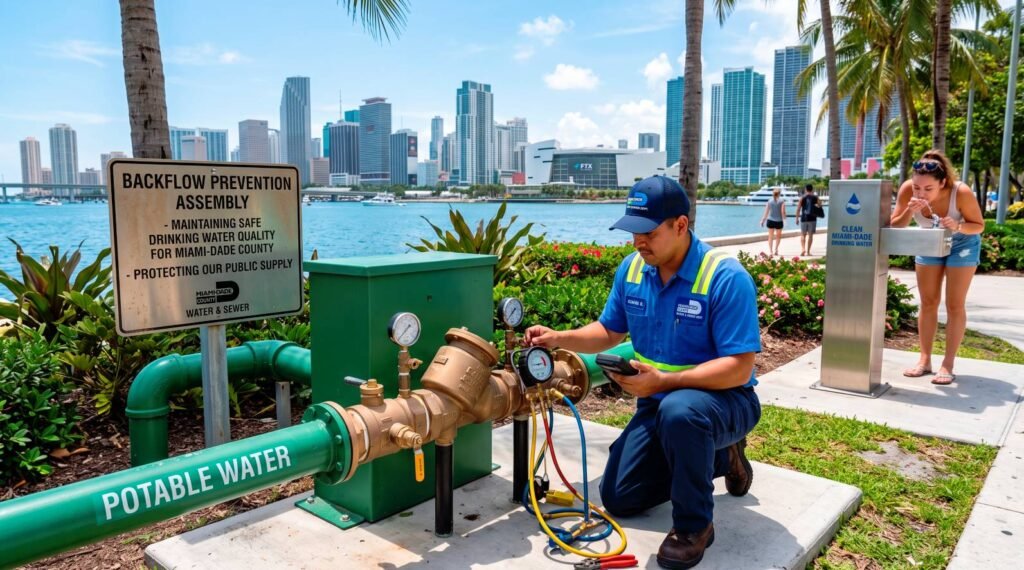
Safe drinking water is the foundation of public health and municipal infrastructure. In Miami-Dade County, where high water tables, intensive commercial operations, and complex irrigation networks intersect, protecting the potable water supply from cross-connection contamination is not just best practice, it is strictly enforced by county and state law.
For licensed plumbing contractors, facility managers, and property owners, understanding cross-connection control, selecting the right backflow prevention assemblies, and sourcing code-compliant components are vital for passing mandatory inspections and preventing catastrophic health hazards.
1. What Is Backflow and Why Is It a Critical Risk in South Florida?
Backflow is the unwanted reversal of water flow from a private plumbing network, commercial facility, or irrigation zone back into the municipal potable water supply. When backflow occurs, non-potable liquids, chemical fertilizers, industrial fluids, or bacteria can siphon directly into clean drinking lines.
Backflow is triggered by two hydraulic mechanisms:
-
Back-Siphonage (Negative Pressure): Occurs when pressure in the public main drops suddenly below atmospheric pressure, commonly caused by water main breaks, heavy firefighting demand, or municipal pump interruptions. This creates a vacuum suction effect, pulling water backward into the system.
-
Back-Pressure (Elevated Downstream Pressure): Occurs when downstream equipment (such as booster pumps, boilers, pressurized chemical mixing lines, or elevated storage tanks) creates pressure higher than the supply main, forcing non-potable water back across the meter.
In South Florida, high ambient heat, mineral-heavy water, and frequent severe weather events increase pressure volatility across supply lines, making mechanical backflow prevention essential for everyday operations.
2. Miami-Dade County Regulations & WASD Compliance Mandates
Under Chapter 32 of the Code of Miami-Dade County and the rules governed by the Florida Administrative Code (F.A.C.), the Miami-Dade Water and Sewer Department (WASD) Cross-Connection Control Program mandates backflow assemblies at all service connections posing an actual or potential hazard.
Properties Requiring Backflow Prevention:
-
Commercial & Industrial Facilities: Auto repair shops, dry cleaners, car washes, and manufacturing plants.
-
Medical & Dental Facilities: Hospitals, clinics, and laboratories with chemical or biological waste streams.
-
Dedicated Fire Protection Systems: Fire lines connected to municipal water mains.
-
Commercial & Residential Irrigation Systems: Especially systems equipped with chemical injection, fertilizer dispensers, or auxiliary pump backups.
-
Multi-Family & High-Rise Buildings: Multi-unit properties with booster pump assemblies.
Annual Certification Requirements
Because backflow assemblies rely on mechanical springs, moving poppets, and internal rubber check discs that degrade over time, Miami-Dade WASD requires every installed assembly to undergo:
-
Testing upon initial installation before water service activation.
-
Mandatory annual testing and recertification conducted by a certified backflow tester.
-
Digital report submission to the county’s central cross-connection database to maintain active water service status.
3. Selecting the Right Backflow Prevention Assembly
Choosing the correct backflow assembly depends directly on the hazard classification (high health hazard vs. low aesthetic hazard) and continuous vs. intermittent pressure demands:
| Assembly Type | Abbreviation | Hazard Level | Typical Application | Operating Mechanism |
| Reduced Pressure Zone Assembly | RPZ / RPPA | High Hazard (Toxic / Health) | Commercial kitchens, medical facilities, chemical lines, car washes | Two independent check valves separated by a hydraulically operated relief valve. Dumps water if checks fail. |
| Double Check Valve Assembly | DCVA | Low Hazard (Non-Toxic) | Standard fire lines, light commercial buildings without chemical injection | Two independently acting, spring-loaded check valves with test cocks and shutoff valves. |
| Double Check Detector Assembly | DCDA | Low / Fire Hazard | Dedicated fire sprinkler lines requiring leak detection | Double check assembly paired with a bypass meter to detect unauthorized water use or leaks. |
| Pressure Vacuum Breaker | PVB | Medium / High (Back-siphonage only) | Lawn sprinkler & landscape irrigation systems | Spring-loaded check valve and air inlet valve; must be installed at least 12″ above highest downstream outlet. |
4. Why Backflow Devices Fail in South Florida (and How to Prevent It)
Contractors in South Florida routinely encounter backflow device failures caused by local environmental stressors:
-
Mineral Scale & Debris Buildup: Hard water calcium carbonate builds up on check valve seats, preventing full closure.
-
UV & Humidity Degradation: Outdoor installations without proper UV-resistant enclosures degrade elastomeric rubber seals and O-rings prematurely.
-
Water Hammer & Pressure Surges: Rapid solenoid shutoffs from commercial irrigation or washing systems shock internal springs and relief diaphragms.
-
Theft & Vandalism: High scrap values for bronze assemblies make exposed backflow devices vulnerable. Miami-Dade WASD recommends installing secure protective cages or building concrete barrier walls to protect outdoor equipment.
5. Pro Contractor Checklist: Installing & Servicing Backflow Assemblies
To ensure your installation passes WASD inspection on the first attempt:
-
[ ] Verify Approvals: Ensure the assembly model and size are listed on the Miami-Dade WASD Approved Products registry.
-
[ ] Install Upstream Strainers: Place a sediment strainer ahead of the backflow assembly (on non-fire lines) to keep sand and mineral scale from jamming the check seats.
-
[ ] Provide Adequate Clearances: Maintain minimum 12-inch to 30-inch clearances around the test cocks and shutoff valves for gauge connections and maintenance access.
-
[ ] Install Proper Drainage: RPZ relief valves require an air-gap drain adapter sized to discharge full relief valve flow without submerging the assembly.
-
[ ] Keep Replacement Repair Kits in Stock: Always have rubber replacement parts (poppet seals, check discs, and relief valve diaphragms) ready for annual recertification failures.
Sourcing Certified Backflow Assemblies in South Florida
Keeping commercial facilities and residential developments compliant requires access to commercial-grade valves, certified test fittings, and fast turnaround on repair kits.
At FC Plumbing Supply, we stock complete lines of lead-free bronze and stainless steel backflow prevention assemblies (RPZ, DCVA, PVB), shutoff valves, test cocks, strainers, and factory rebuild kits from leading manufacturers.
-
Learn more about our local industry partnerships and contractor support on our About Us page.
-
Browse our complete inventory of rough plumbing supplies, valves, and fittings in our Online Shop or visit our Hialeah counter for pro-grade parts and same-day contractor pickup.