Published by FC Plumbing Supply
South Florida’s climate is one of the most demanding environments in the country for residential and commercial plumbing systems. Year-round humidity levels often above 70%, combined with heat, salt air, and heavy seasonal rainfall, create ideal conditions for corrosion, condensation damage, and premature pipe failure. Homeowners, contractors, and property managers in Miami-Dade, Broward, and Palm Beach counties frequently deal with plumbing problems that simply don’t occur at the same rate in drier climates.
This guide explains exactly how humidity damages plumbing systems in South Florida, and which materials and products help prevent that damage — so you can build or repair systems that actually hold up. If you’re sourcing materials for a repipe or new installation, you can browse corrosion-resistant plumbing supplies in our online shop, or contact our team for product recommendations specific to your project.
Why South Florida Humidity Is So Hard on Plumbing
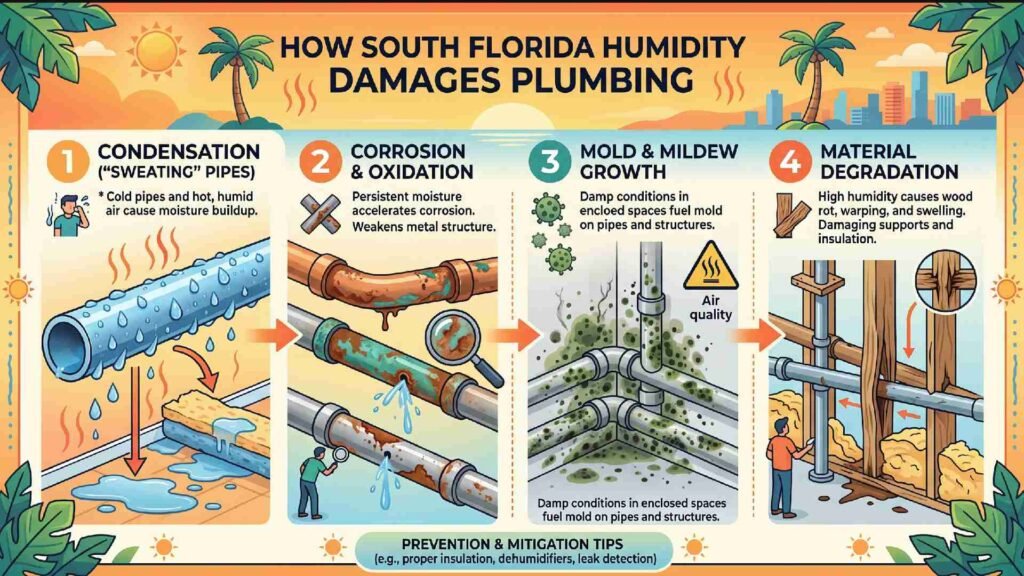
High ambient moisture in the air doesn’t just make pipes “sweat.” It actively accelerates several forms of physical and chemical degradation:
1. Condensation Buildup on Pipes
When warm, humid air contacts cold water pipes (especially cold water lines, AC condensate lines, and pipes running through unconditioned attics or crawl spaces), water condenses on the exterior of the pipe. Over time, this constant moisture:
- Promotes mold and mildew growth on and around pipe insulation
- Deteriorates drywall, wood framing, and insulation surrounding pipes
- Creates a persistent damp environment that accelerates external corrosion on metal pipes and fittings
2. Accelerated Corrosion of Metal Components
Humidity combined with South Florida’s coastal salt air is particularly aggressive toward:
- Galvanized steel pipe (prone to rust and scale buildup)
- Copper fittings (susceptible to pitting corrosion in humid, chloride-rich air)
- Steel brackets, hangers, and fasteners supporting pipe runs
This is compounded in coastal zones where airborne salt particles mix with atmospheric moisture, creating a mild electrolytic environment that speeds up oxidation. Local building codes reflect this reality — Miami-Dade County’s plumbing permit and code requirements account for the region’s unique corrosion and humidity challenges when specifying approved materials, and cities like Hialeah enforce these same standards through their own Building Department.
3. Mold and Mildew in Wall Cavities and Crawl Spaces
Leaky or sweating pipes inside walls create hidden moisture pockets. Because South Florida homes rarely have basements, plumbing often runs through slab foundations, attics, or exterior-adjacent walls — areas where trapped humidity has nowhere to escape. This leads to mold growth long before a visible leak ever appears.
4. Water Heater and Tank Degradation
Humidity increases the rate of external tank corrosion, particularly around fittings, the anode rod access point, and the base of the unit, shortening the functional lifespan of both tank and tankless water heaters if they aren’t properly ventilated.
5. PVC and CPVC Expansion/Contraction Stress
While plastics resist corrosion, Florida’s heat-humidity cycle (hot, wet days and cooler, drier nights) causes repeated thermal expansion and contraction. Poorly installed or unsupported PVC/CPVC runs can develop stress cracks or joint fatigue over years of this cycling.
The Materials That Actually Prevent Humidity-Related Plumbing Damage
Choosing the right materials up front is far cheaper than repairing hidden water damage later. Here’s what performs best in South Florida conditions:
PEX Piping
PEX (cross-linked polyethylene) has become the go-to choice for South Florida repipes and new construction because it:
- Doesn’t corrode or pit like copper
- Flexes with thermal cycling instead of cracking
- Resists scale buildup common in hard water areas
- Performs well in humid wall cavities since it doesn’t sweat as readily as bare copper
CPVC and PVC with Proper Insulation
PVC and CPVC remain excellent, cost-effective, corrosion-proof options — but only when paired with closed-cell foam pipe insulation on cold water lines to prevent condensation drip and mold growth in enclosed spaces.
Type L Copper (When Copper Is Required)
For jobs where copper is preferred or code-required, Type L copper (thicker wall than Type M) offers more corrosion margin. Pairing it with dielectric unions where copper meets steel prevents galvanic corrosion — a common issue in humid coastal environments.
Closed-Cell Foam Pipe Insulation
This is one of the single most effective, low-cost upgrades for humidity control. Closed-cell foam:
- Prevents condensation from forming on cold water lines
- Reduces energy loss on hot water lines
- Resists moisture absorption (unlike open-cell or fiberglass insulation, which can hold water against the pipe)
Stainless Steel or PVC-Coated Fasteners and Hangers
Standard steel hangers and brackets rust quickly in humid, salt-air environments. Stainless steel or PVC-coated hardware significantly extends the service life of pipe supports, especially in attics, crawl spaces, and exterior-adjacent installations.
Brass and No-Lead Bronze Fittings
For fittings exposed to humidity and occasional water contact (hose bibs, exterior shutoffs), brass and bronze resist corrosion far better than standard steel and hold up well against Florida’s combination of heat, salt air, and moisture.
Properly Vented Water Heater Enclosures
Ensuring water heaters — especially those in garages, closets, or attics — have adequate ventilation reduces ambient humidity buildup around the unit, slowing external tank and fitting corrosion.
Practical Recommendations for Contractors and Homeowners
- Insulate every cold water line running through attics, crawl spaces, or unconditioned areas — condensation control is not optional in this climate.
- Specify PEX or well-insulated CPVC for repipes rather than bare copper where budget and code allow.
- Use stainless or coated hardware for all hangers, brackets, and fasteners in humid or coastal-exposed areas.
- Install dielectric unions anywhere dissimilar metals connect to prevent galvanic corrosion.
- Inspect attic and crawl space plumbing annually — hidden condensation damage often goes unnoticed until mold or a slow leak becomes visible.
- Ventilate water heater closets to reduce ambient humidity around tank fittings and connections.
Frequently Asked Questions
Does PEX piping perform better than copper in South Florida? For most residential applications, yes. PEX resists corrosion and pitting caused by humidity and salt air, and it tolerates Florida’s thermal cycling better than rigid copper in many installation contexts. Copper is still used and code-compliant, but typically requires more corrosion protection in humid, coastal settings.
Why do my pipes “sweat” even when there’s no leak? Condensation forms when humid air contacts a cold pipe surface. This is extremely common in South Florida due to consistently high ambient humidity, and it’s a leading cause of hidden mold growth around plumbing — not necessarily a sign of a leak.
What’s the most cost-effective upgrade to prevent humidity damage? Closed-cell foam pipe insulation on cold water lines is typically the highest-impact, lowest-cost improvement available for both new installations and retrofits.
Do I need special fasteners for plumbing in Florida? In humid or coastal-adjacent areas, yes — stainless steel or PVC-coated hangers and brackets last significantly longer than standard galvanized steel hardware.
FC Plumbing Supply stocks PEX, CPVC, insulation, corrosion-resistant fittings, and hardware built for South Florida’s climate. Visit your local branch or browse our catalog for materials suited to humid, coastal installations.