Key Facts & Technical Summary (Quick Reference)
-
Governing Fuel Gas Codes: Florida Building Code (Fuel Gas), 8th Edition (2023/2026 amendments), NFPA 54 (National Fuel Gas Code), Chapter 4 (Gas Piping Installations).
-
Mandatory Appliance Standards: ANSI Z21.24 / CSA 6.10 (Stationary appliances) and ANSI Z21.69 / CSA 6.16 (Movable commercial cooking equipment on casters).
-
Material Composition: Corrugated 304 Stainless Steel Tubing (CSST) protected with 360-degree hot-melt high-visibility yellow polymer coating for corrosion resistance against chlorides and household cleaning chemicals.
-
Prohibited Code Violations: Joining or splicing two connectors together; running flexible lines through walls, ceilings, partitions, floors, or appliance cabinets; omitting upstream manual gas shut-off valves within 6 feet; and reusing existing gas connectors during equipment replacement.
-
Local In-Stock Sizing: 3/8″ ID (1/2″ OD) and 1/2″ ID (5/8″ OD) in 36″, 48″, 60″, and 72″ lengths with factory-attached zinc-dichromate steel or brass MIP/FIP flare adapters.
Installing and replacing gas appliances in South Florida—ranging from high-demand commercial kitchen ranges in Hialeah to whole-house tankless water heaters and standby hurricane generators—demands zero margin for error. Gas leaks pose severe safety hazards, and Miami-Dade building inspectors enforce strict standards regarding material ratings, corrugation integrity, and approved connections under the Florida Building Code, Fuel Gas (Chapter 4) and NFPA 54 (National Fuel Gas Code).
A frequent failure point during residential and light commercial inspections is the improper selection of flexible gas appliance connectors. Using an undersized connector starves appliances of necessary pressure, while using non-certified lines in coastal, high-humidity environments leads to accelerated exterior corrosion. Much like the structural risks detailed in our guide on The Hidden Cost of Cheap Plumbing Materials in South Florida, cutting corners on gas lines can lead to immediate inspection failures or catastrophic gas leaks.
Plumbing and mechanical contractors must verify material ratings, flow metrics, and code boundaries before connecting any line to a gas train.
1. Regulatory Standards: ANSI Z21.24 vs. ANSI Z21.69
Building codes distinguish clearly between stationary appliances and movable commercial equipment:
-
ANSI Z21.24 / CSA 6.10: Regulates connectors for stationary gas appliances (water heaters, furnaces, stationary ranges, and clothes dryers). These lines are engineered to absorb vibration and minor structural shifts but are not designed for repeated movement.
-
ANSI Z21.69 / CSA 6.16: Required for commercial food service equipment mounted on casters that must be moved regularly for cleaning, requiring restraining cables and quick-disconnect fittings. If you are outfitting food-handling operations alongside grease interceptor systems (see our Miami-Dade Commercial Grease Trap Compliance Guide), verifying this standard on all movable cook lines is mandatory.
-
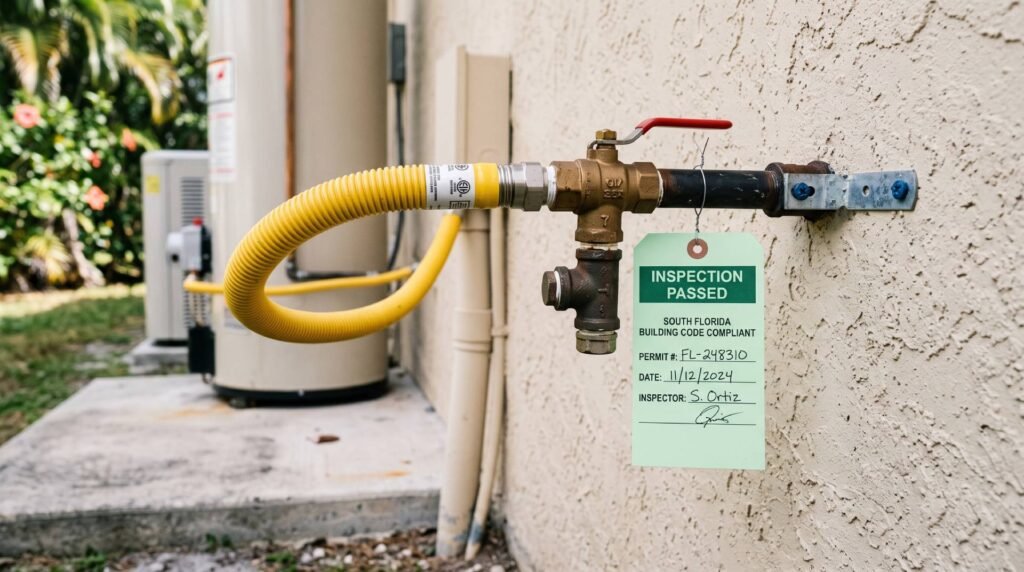
Yellow Epoxy Coating: In Florida’s salty, humid atmosphere, bare corrugated stainless steel tubing exposed to cleaning chemicals (such as bleach or ammonia) is vulnerable to stress-corrosion cracking. High-visibility yellow polymer coating provides an essential barrier against chemical corrosion, moisture, and electrical conductivity.
2. Connector Diameter vs. BTU Capacity: Avoiding Starvation
A common mistake in the field is sizing a flexible gas line strictly by the pipe thread fitting on the wall rather than the total BTU demand and total length of the run. As connector length increases, internal friction drop increases, reducing maximum flow capacity.
The following reference guide displays maximum flow rates for certified yellow-coated flexible gas connectors operating on Natural Gas (0.64 Specific Gravity, 1,000 BTU/cu. ft., with a 0.5-inch water column pressure drop):
| Nominal Inside Diameter (ID) | Outside Diameter (OD) | Length | Minimum / Maximum BTU Capacity (NG) | Recommended Applications |
| 3/8″ ID | 1/2″ OD | 36″ | 71,100 BTU/hr | Residential clothes dryers, small cooktops |
| 3/8″ ID | 1/2″ OD | 60″ | 53,200 BTU/hr | Low-BTU wall heaters, compact fireplaces |
| 3/8″ ID | 1/2″ OD | 72″ | 49,100 BTU/hr | Low-demand appliances with extended offset |
| 1/2″ ID | 5/8″ OD | 36″ | 125,000 BTU/hr | High-recovery storage tank water heaters, standard ranges |
| 1/2″ ID | 5/8″ OD | 48″ | 106,000 BTU/hr | Residential cooking suites, commercial prep burners |
| 1/2″ ID | 5/8″ OD | 60″ | 93,200 BTU/hr | Standard residential cooktops with distant manifold valves |
| 3/4″ ID | 7/8″ OD | 36″ | 200,000+ BTU/hr | High-demand tankless water heaters (199k BTU), heavy commercial fryers |
Note: For Liquid Propane (LP) gas calculations, multiply the natural gas capacity values above by 1.6.
3. Critical Code Requirements for South Florida Inspections
Before requesting an inspection from the Miami-Dade County Department of Regulatory and Economic Resources (RER) or local municipal building departments, verify the following installation requirements:
-
One Connector Per Appliance: Connectors cannot be joined together. Splicing two 36-inch flexible lines together to create a 72-inch line is a direct violation. If the distance exceeds allowable connector lengths, you must extend the rigid black iron pipe closer to the appliance.
-
Concealment Restrictions: Flexible appliance connectors must never pass through walls, floors, partitions, ceilings, or appliance housings. They must remain fully visible and accessible within the same room as the appliance.
-
Dedicated Shut-Off Valve: Each appliance must have an accessible, listed manual gas shut-off valve located upstream of the connector, within 6 feet of the appliance, and in the same room.
-
No Re-Use Policy: When replacing an old water heater or stove, never re-use the existing flexible line. The flare seats and metal corrugations deform when torqued; reusing them drastically increases the likelihood of micro-leaks.
Frequently Asked Questions (Code & Installation Compliance)
What is the maximum allowable length for a flexible gas connector under the Florida Building Code?
Under Chapter 4 of the Florida Building Code (Fuel Gas), flexible connectors for domestic appliances (such as ranges and clothes dryers) must not exceed 6 feet (72 inches) in total nominal length. Connectors for commercial cooking appliances mounted on casters or stationary equipment must comply with the specific length tolerances specified by their ANSI Z21.69 listing and cannot be coupled together.
Can an Easyflex yellow-coated flexible gas connector be concealed behind drywall?
No. Flexible gas appliance connectors must never pass through walls, floors, ceilings, partitions, or appliance housings. They must remain fully visible and directly accessible within the same room where the appliance is installed to allow periodic visual inspection and leak detection.
Why is yellow epoxy coating necessary on stainless steel gas connectors in coastal South Florida?
Yellow polymer epoxy coating provides non-conductive protection against moisture, marine salt air, and common household chemicals such as bleach and ammonia. In high-humidity coastal climates like Miami-Dade, uncoated corrugated stainless steel can experience chloride-induced stress-corrosion cracking over time.
Can flexible gas connectors be reused when installing a new appliance?
No. Appliance gas connectors are strictly single-use products. When a flare fitting is torqued down, the metal flare seat compresses to form a gas-tight seal. Re-torquing a previously seated fitting or bending pre-stressed corrugations compromises the seal and can cause dangerous micro-fractures.
Stock Up on Certified Gas Supplies at FC Plumbing Supply
FC Plumbing Supply stocks certified Easyflex yellow-coated flexible gas connectors in 3/8″ and 1/2″ ID configurations ranging from 36″ to 72″, along with MIP/FIP brass adapter fittings, shut-off valves, and black malleable iron fittings.
Whether you are completing a residential gas retrofit or outfitting a commercial kitchen, browse our verified catalog on our online shop or contact our counter team at our Hialeah supply center for job-lot quotes and contractor pricing.